Running high-rise tower sales end to end at Bootes Infrastructure
Bootes Infrastructure Limited runs sales, collections, and compliance for NBCC high-rise tower developments on CodePattern's Real Estate CRM & ERP — from first inquiry to registry and NOC.
Bootes Infrastructure Limited sells and administers high-rise residential towers built by NBCC. Selling a tower is not a single transaction — it is a multi-year sequence of inquiries, site visits, unit blocks, applications, KYC, agreements, staged payment demands, statutory deductions, and finally registry and no-objection certificates.
CodePattern's Real Estate CRM & ERP runs that sequence in production. Rather than stitching a CRM to a spreadsheet to an accounting package, the platform holds the entire lifecycle on one data model, so a unit's commercial status, its customer, its payment schedule, and its compliance state never disagree with each other.
From inquiry to qualified pipeline
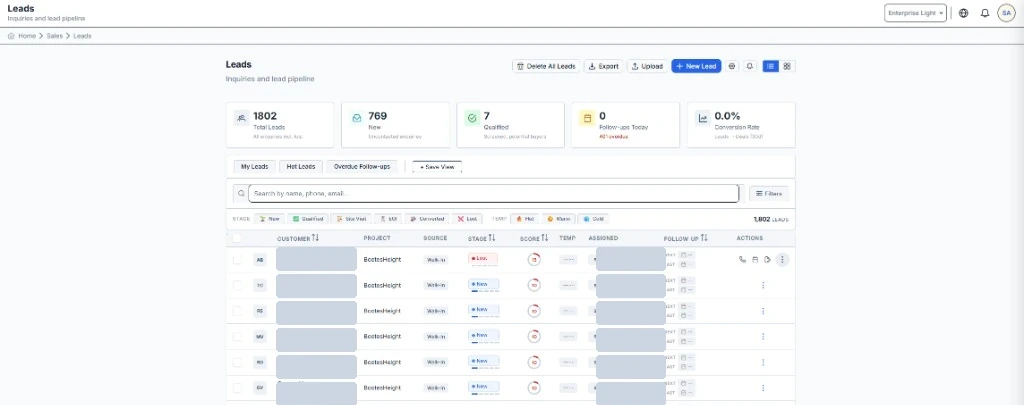
Sales operations begin in a single lead workspace: capture and import, source attribution, stage progression, scoring and temperature, assignment and reassignment across the sales team, site-visit scheduling, and follow-up tracking with overdue visibility.
Because source attribution is captured at the point of entry, the platform reports conversion and pipeline value by channel — walk-in, referral, website, or broker — instead of leaving channel performance to guesswork at the end of a quarter.
Inventory that reflects reality
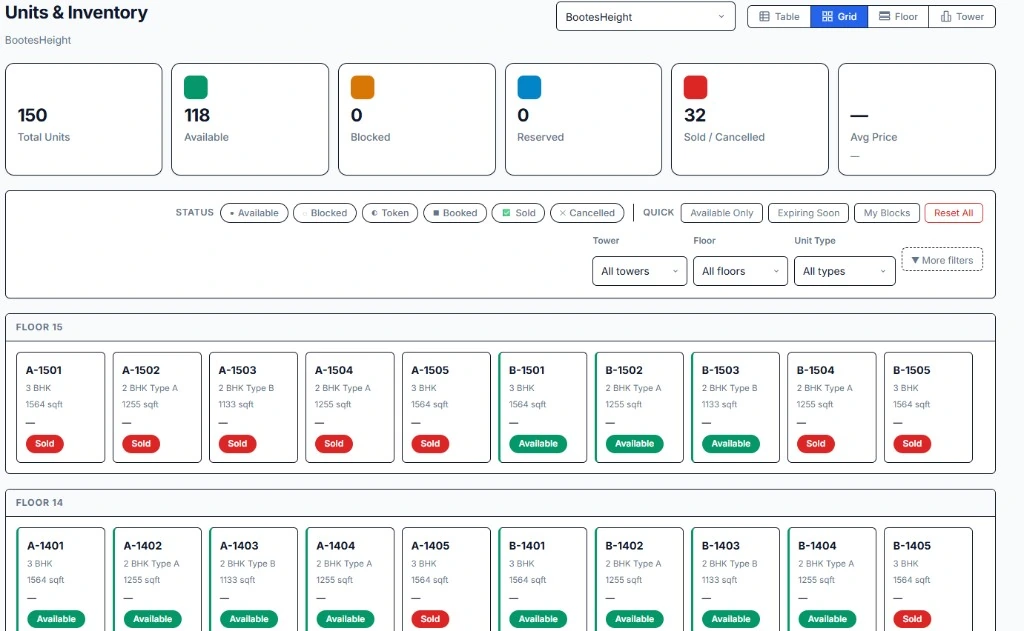
Tower inventory is modelled the way the sales floor actually thinks about it. The same 150-unit development can be viewed as a table, a grid, a floor plate, or a tower elevation, with availability, blocks, tokens, bookings, and sold units reconciled in one place.
Unit-level detail carries configuration and area alongside commercial status, so a block placed during a negotiation is visible to everyone immediately — which is what prevents the double-selling and stale-availability problems that spreadsheets reliably produce.
Deal execution with controls, not conventions
Each deal moves through a pre-approval checklist that separates required gates from advisory ones: customer application approved, KYC verified, charges finalised, token or booking payment received, agreement uploaded. The deal advances only when the required gates are satisfied.
Once a deal's financial summary is locked, changes are not edits — they are amendment requests. That single design decision converts a common source of revenue leakage and audit findings into a reviewable, attributable workflow.
Collections and statutory compliance in the same system
Finance operates on the same records as sales: payment schedules and demand notes, receipts and online payments, ledgers, overdue tracking, refunds, discounts pending approval, and revenue recognition.
The compliance surface is handled in-platform rather than alongside it — RERA management, NACH mandate management for recurring collections, TDS certificates against Form 26QB, subvention arrangements, and NOC dispatch. Registry and NOC status sit on the deal record itself, so the handover stage is as governed as the sale.
Channel partners and governance
Broker relationships are first-class: partner records, a broker dashboard, configurable commission rules, commission calculation, and leaderboards. Commission logic lives in the system that already knows the booking, which removes the reconciliation step entirely.
Administration is built for a real operating team — role-based users, developer-company separation, reminder rules, integration settings, geofenced attendance for field sales, a job monitor for background processing, and an audit log across the platform.
Why this matters
The platform is not a pilot or a prototype. It carries live pipeline, live inventory, live money movement, and live statutory obligations for an enterprise developer — which is a materially different engineering standard than a demo.
It also reflects how CodePattern builds: model the domain properly, put controls where money and compliance are involved, and make the connected system the reason the operation gets easier as it scales.